Berger Elected to the Milwaukee House of Representative
Sewer socialism was an originally pejorative term for the American socialist motion that centered in Milwaukee, Wisconsin, from around 1892 to 1960.[ane] The term was coined past Morris Hillquit at the 1932 Milwaukee convention of the Socialist Party of America as a commentary on the Milwaukee socialists and their perpetual boasting about the splendid public sewer organization in the city.[2]
History [edit]
Background [edit]
With the creation of the Socialist Political party of America, this group formed the cadre of an element that favored reformism rather than revolution, de-emphasizing social theory and revolutionary rhetoric in favor of honest government and efforts to improve public wellness. The sewer socialists fought to clean up what they saw as "the muddy and polluted legacy of the Industrial Revolution",[3] cleaning up neighborhoods and factories with new sanitation systems, urban center-owned water and ability systems and improved education. This arroyo is sometimes chosen "constructive socialism".[four] The movement has its origins in the system of the Social Democratic Political party, a precursor to the Socialist Party of America. Even before the creation of the Social Democratic Political party, Milwaukee had elected socialist millwright Henry Smith (who had been elected to the legislature under the "Socialist" characterization) to Congress on the Union Labor ticket in 1886.
Victor Berger [edit]

Victor L. Berger, Representative of Wisconsin's fifth commune in the 61st and 67th–72nd Congresses
Victor L. Berger was one of the prime number movers of sewer socialism,[3] oft compared to Robert La Follette and his representation of progressivism. He was an Austrian Jewish immigrant who published English and German daily newspapers, distributing costless copies to every household in Milwaukee before elections. He was the best-known local leader of this trend. In 1910, he became the first of two 20th-century Socialists elected to the House of Representatives, representing Wisconsin's 5th congressional district (the second was Meyer London of New York). Berger was reelected in 1918, just he was barred from his seat in the Firm because of his trial and conviction under the 1917 Espionage Act for his public remarks opposing intervention in Earth War I. A special election was called in which Berger again emerged victorious, but he was denied the seat and it was alleged vacant. Berger served the fifth district once more from 1923 until 1929 and during his tenure introduced proposals for numerous programs that were afterwards adopted, such as old historic period pensions, unemployment insurance and public housing.
Electoral success [edit]
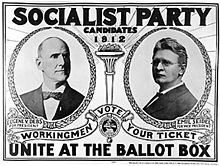
In 1910, the Socialists won most of the seats in the Milwaukee city quango and county board. This included the first Socialist mayor in the United States, Emil Seidel, who also received the nomination for Vice President on the Socialist Party of America ticket in the 1912 election when the Socialists netted 6% of the vote, their highest-e'er percentage. Seidel and Berger both lost their campaigns in 1912, simply in 1916 a new socialist mayor was elected, Daniel Hoan, who remained in office until 1940. Socialists never regained full control over the local authorities as they did in 1910, but they continued to bear witness major influence until the defeat of Daniel Hoan in 1940. The sewer socialists elected ane more than mayor in Milwaukee, Frank Zeidler, who served for 3 terms (1948–1960). A member of a socialist political party has not been elected mayor of a major American urban center since the stop of Zeidler's tenure, although independent democratic socialist Bernie Sanders was elected mayor of Burlington, Vermont in 1981. In the Autonomous Political party primary for the 2022 Buffalo mayoral election, self-identified socialist India Walton scored an upset victory over incumbent Byron Brown.[five] However, Dark-brown went on to defeat Walton in the general election as a write-in candidate.[6] Had Walton won, she would accept been the first socialist to serve equally mayor of a major American city since Zeidler.[v]
Relationship with the Wisconsin Progressive Political party [edit]
Although the Socialists had many ideas and policies similar to those of the Wisconsin Progressives, tensions still existed betwixt the two groups because of their differing ideologies. Socialist Assemblyman George Fifty. Tews during a 1932 debate on unemployment compensation and how to fund it argued for the Socialist pecker and against the Progressive substitute, stating that a Progressive was "a Socialist with the brains knocked out".[seven] Although as a rule the Progressives and Socialists did not run candidates against each other in Milwaukee, they rarely co-operated on elections. One notable exception was the 1924 presidential campaign of Robert La Follette, who was endorsed by the Socialist Party of America. A factor that affected this lack of collaboration was the relationship of each party to the Republican Party. Socialists were outright opposed to the political party while the Progressives sometimes worked with their parent party.
In 1961, Progressive editor William Evjue wrote of the Wisconsin Socialist legislators he had known by saying: "They never were approached by the lobbyists, because the lobbyists knew information technology was not possible to influence these men. They were incorruptible."[8]
Run into also [edit]
- Jasper McLevy
- Progressivism in the United states
References [edit]
- ^ "Socialism in Milwaukee". Wisconsin Historical Guild. Archived from the original on Nov four, 2012. Retrieved October eleven, 2009.
- ^ Louis Waldman, Labor Lawyer. New York: Dutton, 1944, p. 260. Hillquit was running against Milwaukee mayor Dan Hoan for the position of National Chairman of the Socialist Party at the 1932 convention, and the insult may take sprung up in that context.
- ^ a b "Milwaukee Sewer Socialism". Wisconsin Historical Order. Archived from the original on March x, 2021. Retrieved October xi, 2009.
- ^ Miller, Sally M. Victor Berger and the Hope of Constructive Socialism Westwood, Connecticut: Greenwood Printing, 1973
- ^ a b Jones, Sarah (June 23, 2021). "It Looks Like Buffalo Will Have a Socialist Mayor". New York. Archived from the original on July 6, 2021. Retrieved August 20, 2021.
- ^ Ryan, Patrick. "Write-ins are counted: Buffalo Mayor Byron Brown wins reelection, defeating Bharat Walton". Buffalo News 4 . Retrieved Nov 24, 2021.
- ^ Kaveny, Edward T. "$10,000,000 Tax: Assembly Passes Compromise Beak by 73 to 15 Vote" Milwaukee Sentinel Jan 6, 1932; p. 1, cols. 7–8
- ^ Evjue, William T. "How-do-you-do, Wisconsin," Capital Times Nov 9, 1961, p. 3, col. 1.
Further reading [edit]
- Brook, Elmer A. The Sewer Socialists: A History of the Socialist Party of Wisconsin, 1897–1940. Fennimore, WI: Westburg Associates, 1982.
- Bekken, Jon. "'No Weapon And then Powerful': Working-Class Newspapers in the Us," Periodical of Communication Inquiry, Vol. 12, No. 2, pp. 104–119 (1988)
- Johnston, Scott D. "Wisconsin Socialists and the Briefing for Progressive Political Action" Wisconsin Mag of History, vol. 37, no. 2 (Winter, 1953–1954): 96–100.
- Jozwiak, Elizabeth. "Politics in Play: Socialism, Costless Speech, and Social Centers in Milwaukee" Wisconsin Magazine of History, vol. 66, no. four (Summer, 1983): 10–21.
- Kerstein, Edward S. Milwaukee'south All-American Mayor: Portrait of Daniel Webster Hoan. Englewood Cliff, NJ: Prentice-Hall, 1966.
- Lorence, James J. "'Dynamite for the Encephalon': The Growth and Turn down of Socialism in Central and Lakeshore Wisconsin, 1910–1920" Wisconsin Magazine of History, vol. 66, no. iv (Summertime, 1983): 250–273.
- McCarthy, John M. Making Milwaukee Mightier: Planning and the Politics of Growth, 1910–1960. DeKalb, IL: Northern Illinois University Press, 2009.
- Miller, Emerge M. Race, Ethnicity, and Gender in Early Twentieth-Century American Socialism. Garland Reference Library of Social Scientific discipline, vol. 880. New York and London: Garland Publishing, 1996.
- Olson, Frederick 50. "The Socialist Party and the Union in Milwaukee, 1900–1912" Wisconsin Mag of History, vol. 44, no. 2 (Winter, 1960–1961): 110–116.
- Zeidler, Frank P. A Liberal in Urban center Government: My Experiences as Mayor of Milwaukee. Milwaukee: Milwaukee Publishers, 2005.
External links [edit]
- John Gurda on How the Socialists Saved Milwaukee
- Socialism earlier it was a four-letter word
- Hither, Socialism meant honest, frugal regime
- Parsing Out the Legacy of Sewer Socialism
bobbittthereastelf.blogspot.com
Source: https://en.wikipedia.org/wiki/Sewer_socialism
0 Response to "Berger Elected to the Milwaukee House of Representative"
Post a Comment